| The orchestra is formed The Alderley Edge Advertiser of 26th May 1922 contained an announcement that a meeting of the Alderley Edge Musical Festival committee had taken place to discuss the formation of an Orchestra. It reported that 'Mr WO West (organist of St Philip's Church, Alderley Edge) had consented to conduct. Weekly rehearsals would begin in the autumn Amongst those attending the meeting was Philip Godlee (below), the nephew of the prominent Manchester businessman Francis Godlee (1854-1928), a man of many interests including astronomy; he presented his Godlee Observatory and telescopes to the City of Manchester in 1903 following the foundation of the Manchester Astronomical Society.Francis Godlee was joint owner (with a relative William Simpson) of a prosperous cotton manufacturers and calico printers Simpson & Godlee,with offices in Manchester and mills in Bolton and Bury. Philip Godlee became owner of the business in 1924. 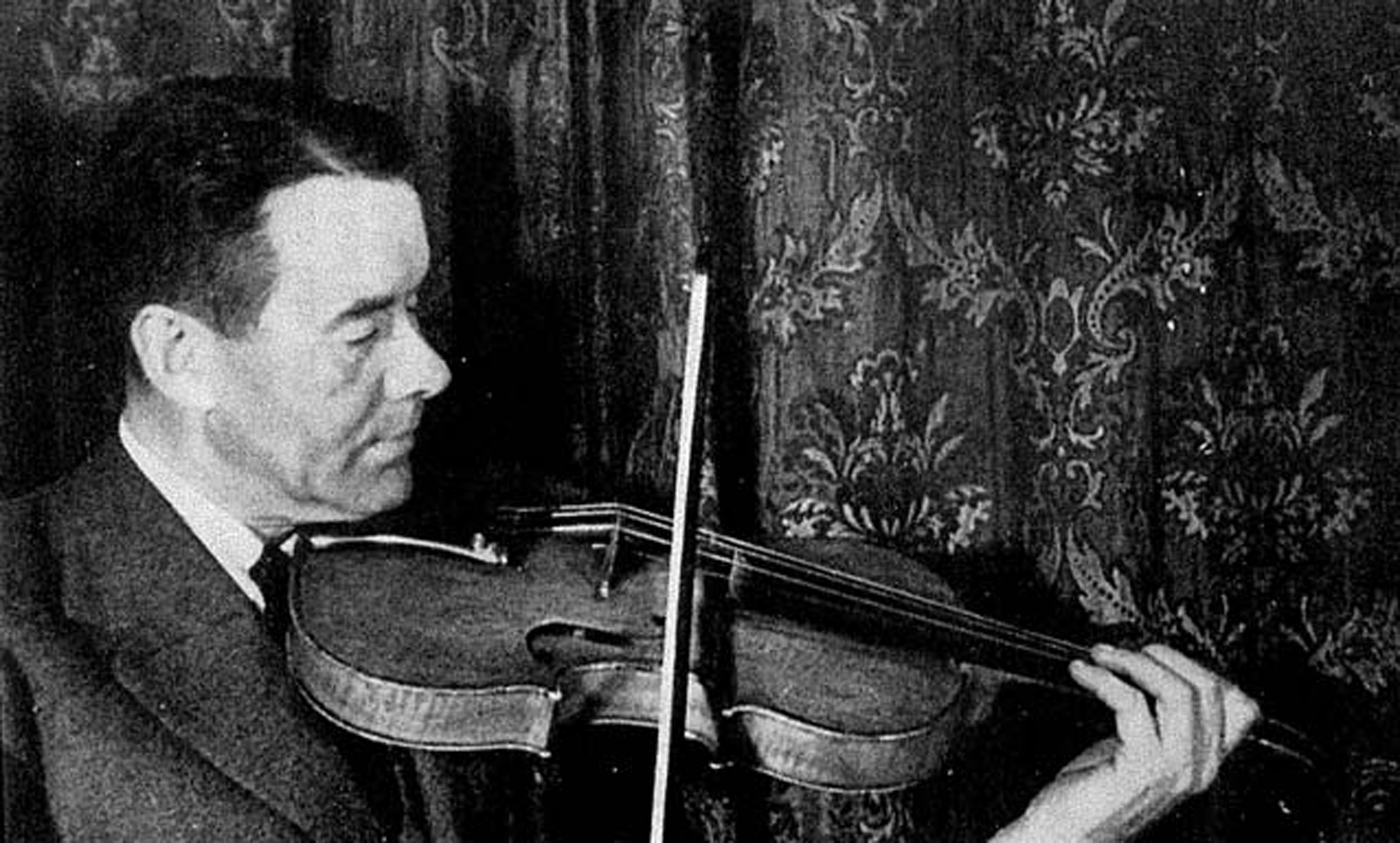 Some of these players in those early years are of particular interest. AG Howarth (violin) became Sir AG Howarth and was Chairman of the Hallé Orchestra in the 1950s and 1960s. Frank Park played viola in the Hallé, and Miss Stancliffe (flute) was the sister of Patricia Stancliffe who played cor anglais in the Hall é both before and during the Barbirolli years. Rev EA Voysey (cello) was father-in-law of the Manchester-born actor Robert Donat (1905-1958) who starred in many films, including the huge hit The Thirty-Nine Steps (1935). To Philip Godlee must go the credit for the development of the orchestra in the early years. The Alderley Edge Orchestral Society gave regular concerts during the late 1920s and 1930s and performed with great success in the Alderley Edge Musical Festival every year from 1927 to 1938. It then temporarily ceased operations on the outbreak of war in 1939. The post-war years After the war, the Orchestra was re-established in its present form in 1952. A preliminary Committee met on 12th June under the chaimanship of Mrs V M Shawcross and agreed, after a discussion ‘at some length’ that the new organisation should be known as ‘The Alderley Edge Orchestral Society’ with the intention of giving an inaugural concert at the end of October or early November. It was agreed that rehearsals would take place at the Belmont Mission Hall in Heyes Lane, premises then owned by the Wesleyan Methodist Church; the building still exists, although it has in recent years been converted into private dwellings. The first formal committee meeting, chaired by Mr T Anderson and with Mrs Shawcross as Treasurer and Miss M A Francis as Secretary, took place a fortnight later on 30th June at Miss Francis ’s home at 28 Carrwood Road, Wilmslow. It was decided that the annual subscription should be £1. 1. 0d [£1.05 in today’s money) and that those attending rehearsals (on Thursday evenings, as today) would be charged 3d [just over 1p] for tea and biscuits. Philip Godlee was invited to be the Society ’s first President, in recognition of his pre-war musical activities. The major item of discussion, as might be expected, was the programme for the first concert. This was discussed ‘at some length’ and in keeping with the concert planning traditions of the day the Committee finally agreed the generous, if somewhat indigestible, offering of:
MOZART Magic Flute Overture
ELGAR Chanson de Matin ELGAR Chanson de Nuit MOZART Horn Concerto No 4, movements 2 and 3 ] (soloist: Ione Petch) WALTIUFULhe Grenadiers ROSSINI William Tell Interval EDWARD GERMAN Nell Gwynn Dances ] MENDELSSOHN Piano Concerto No 1, movements 1 and 2 ERIC COATES London Every Day No 1 [ GRIEG The Last Spring ELGAR Pomp & Circumstance March No 1 GOD SAVE THE QUEEN
The concert, at the Regal Ballroom in Talbot Road, known today as the Festival Hall, tok place on Thursday 23rd October 1952. Conducted by Maurice French, it attracted a sell-out audience of over 400; ticket sales - with prices ranging from 3/6d [18p] for the best seats upstairs to 1/6d [8p] elsewhere - resulted in impressive box office takings of £59. 5.s 0d (£59.25). This would have been the equivalent of over £2.500 today.

Present at the first post-war concert was eminent Alderley Edge writer
Alan Garner. He has clear memories of the occasion. 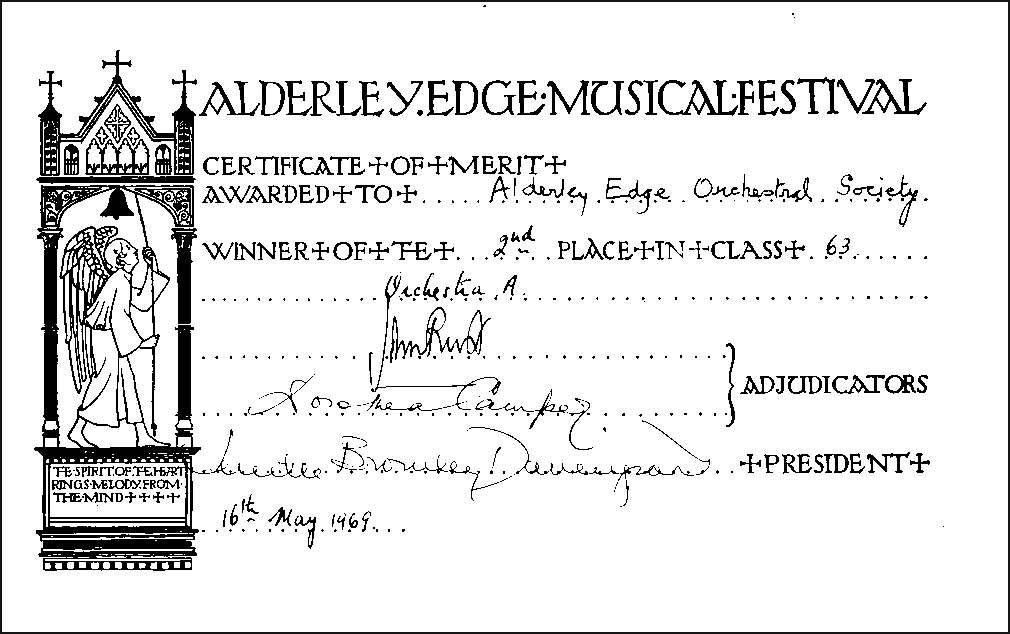
The Orchestra was awarded a Certificate of Merit when it took part in the 1969 Alderley Edge Music Festival
In 1967, conductor Maurine French was succeeded by Ron Yarwood, who in 1984 passed the baton to Timothy Krnda;lwho had played horn in the orchestra since his schooldays. By this time, the orchestra was giving three concerts each season, and in due course a Christmas Concert was introduced. The eminent industrialist Sir Ernest Hall OBE, DL became President of the orchestra in 1989. A talented amateur pianist who trained at the Royal Manchester of Music, he joined the orchestra for Chopin's Second Piano Concerto the following year and Beethoven's Emperor Concerto in 1994. In 1996, former leader of the Hallé Orchestra Martin Milner OBE was soloist in a performance of the Beethoven Violin Concerto. The orchestra was essentially a chamber orchestra in size, without regular heavy brass, which to some extent limited the range of works performed; but in n 2006, we started organising an annual Workshop to give players the opportunity to explore more major compositions without the pressure of formal concert performances. These proved - and remain - hugely popular, attracting 70 or more players on occasion. The orchestra became a Registered Charity in 2002. Richard Howarth, former Leader of the Ulster Orchestra and Manchester Camerata and a guest leader of many other top UK orchestra, became President of the orchestra in 2005 and played an important role in the development of the orchestra in the years that followed. The orchestra has engaged a professional leader. Shahla Armitage, since 2013 and from 2014 the orchestra started to engage professional conductors. Concert programmes became more adventurous and to reflect an enlargement of the orchestra to incorporate full brass and horn sections the name of the orchestra was changed from Alderley Edge Orchestra to Alderley Edge Symphony Orchestra in 2018. To mark the orchestra's Centenary in 2022, we moved into the world of opera for the first time when City of Manchester Opera joined the orchestra for An Evening at the Opera under the baton of popular Spanish conductor Juan Ortunõ. 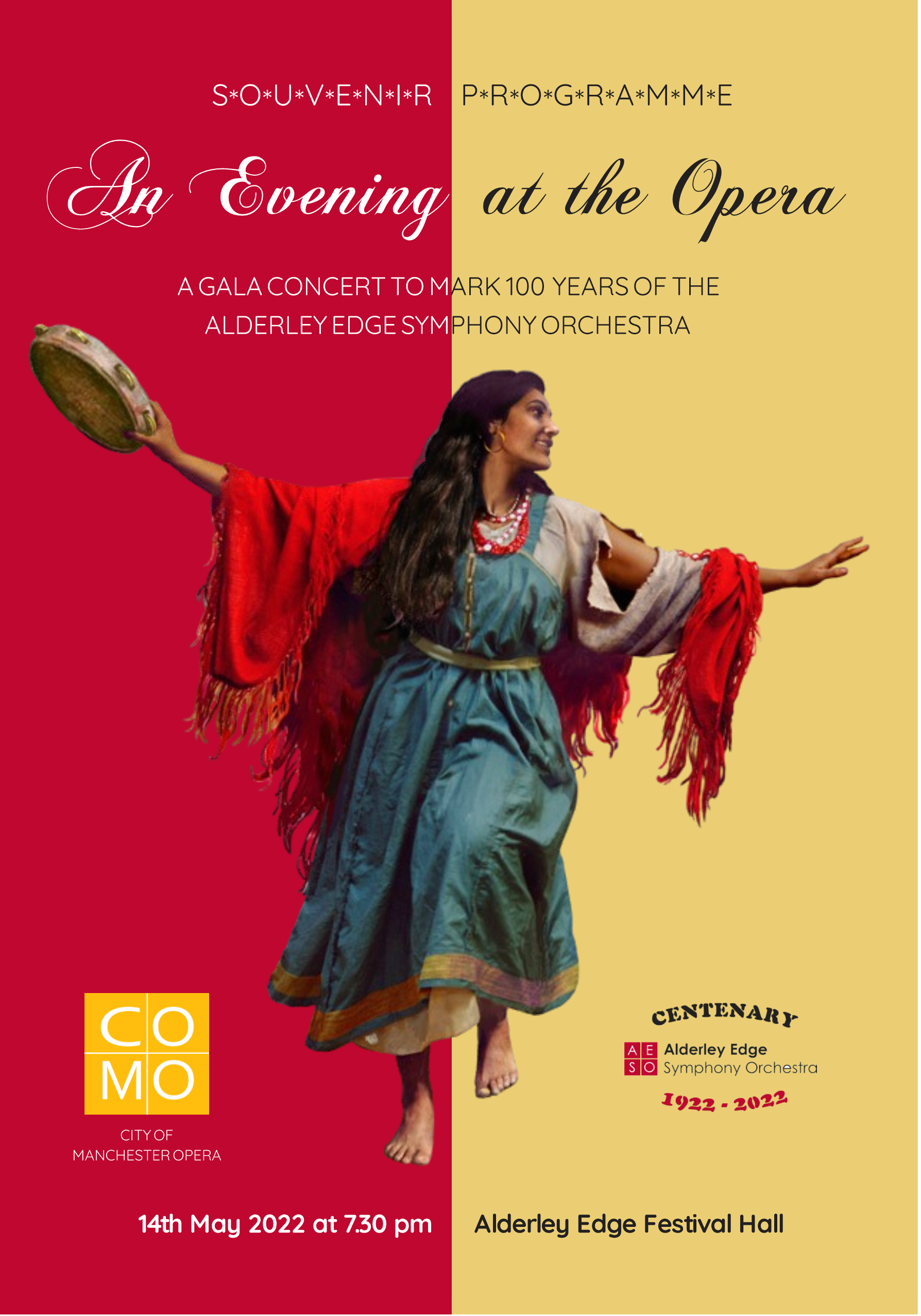
Concert venues Alderley Edge Festival Hall The Festival Hall in Talbot Road was built in 1927 on the initiative of Philip Godlee (who lived nearby at The Meadows, Ryley's Lane) to accommodate the new Alderley Edge Music Festival that had been founded in 1910 by a group led by Charles Crofts. It later ran into financial difficulties and became the Regal Cinema and Ballroom, boasting a unique adjustable floor which could be flat for ballroom dancing and sloping for concerts and other entertainments. Local girls found it an ideal venue to meet American servicemen stationed in the area. After the war it ran into financial difficulties and the premises were used for concerts and more generally as the 'Assembly Rooms'. 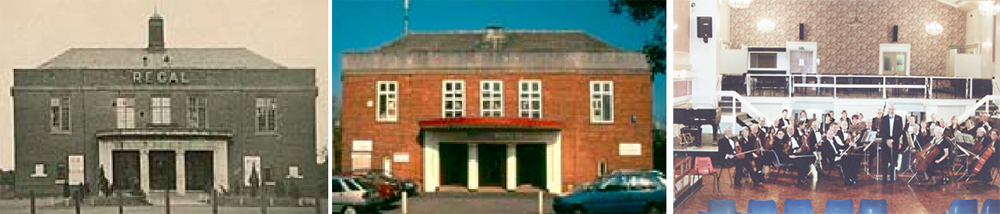
 (Left): The 'Regal Cinema and Ballroom (Centre): The building was later known as the 'Assembly Rooms' (Right): Timothy Kendal conducts the Alderley Edge Orchestra in the Assembly Rooms in early 2000s The name 'Festival Hall' was restored in 1998 but it was becoming increasingly dated and closed for major re-design and refurbishment in 2015/16. Since then it has become the orchestra's principal venue for concerts and the annual Worlshop. 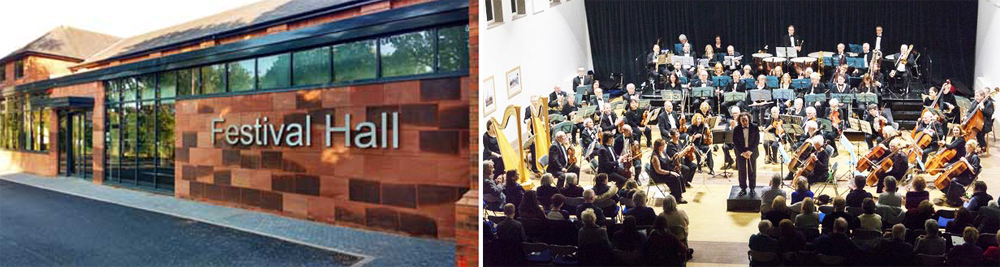 The orchestra first performed in Alderley Edge Methodist Church in 2002 for a concert including of Saint-Saens' 'Organ* Symphony No 3 for which its fine two-manual organ proved well suited. From 2003 to 2016, all concerts were held at the Methodist Church; since then larger concerts are invariably held at the Festival Hall following its refurbishnent, the Methodist Church being used for keyboard events and for the annual Christmas concert 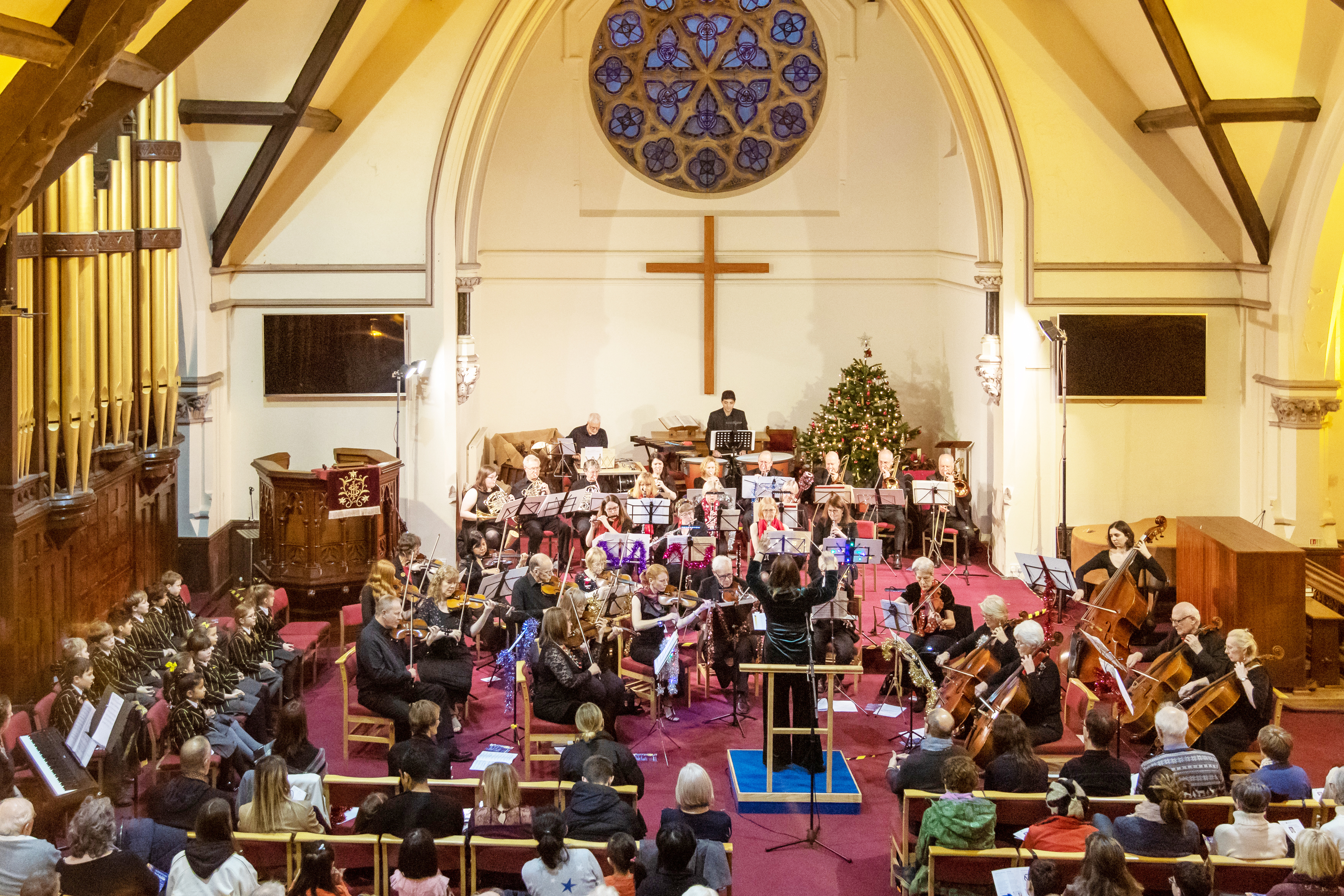
Corporate branding
The orchestras has used four logos over the years. 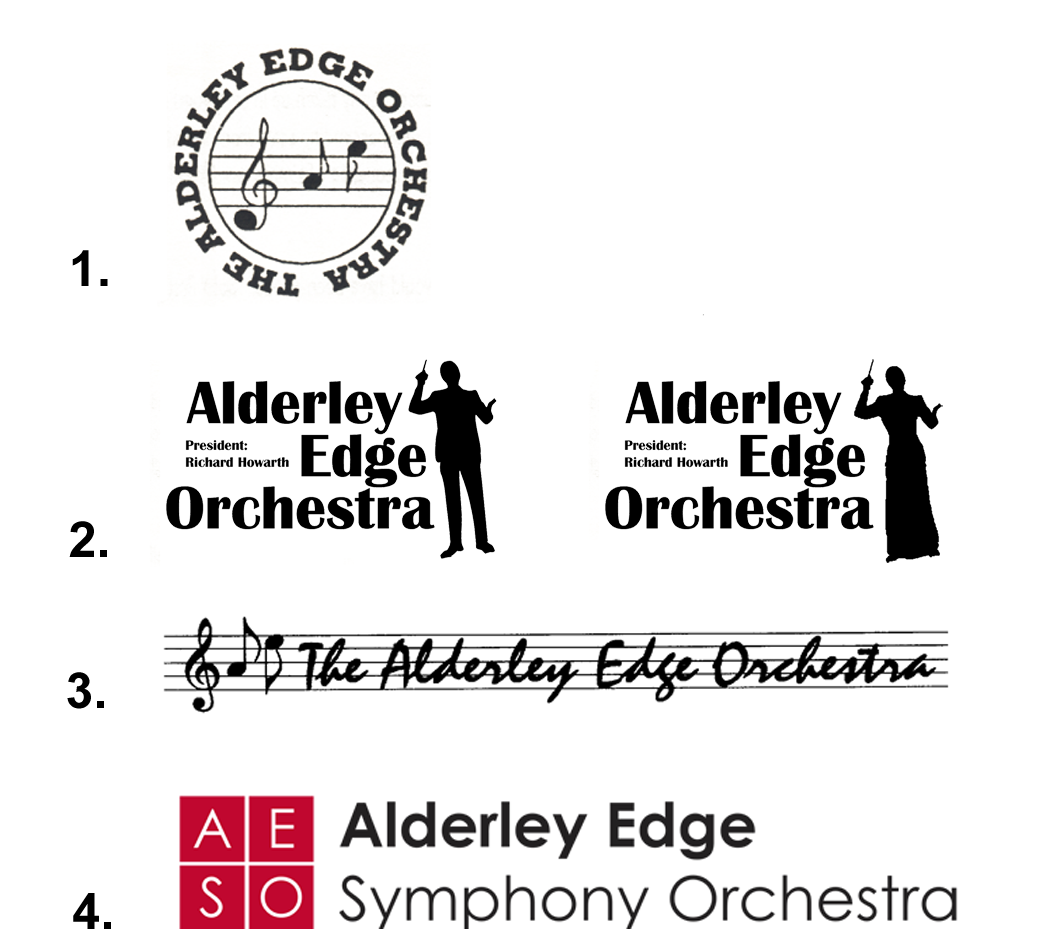
1. The circular design first appeared in 1993. Note that the two notes on the C major scale are (A)lderley amd (E)dge 2. The importance of the conductor was recognised in the logo introduced in 2013. Recognising the importance of diversity, a version with a woman conductor was created, 3. Two years later, it was replaced by the music stave carrying the orchestra's name. . 4. The current logo marks the orchestra's change of name to Alderley Edge Symphony Orcvhestra in 2016. |