Louise Townsend (principal flute)
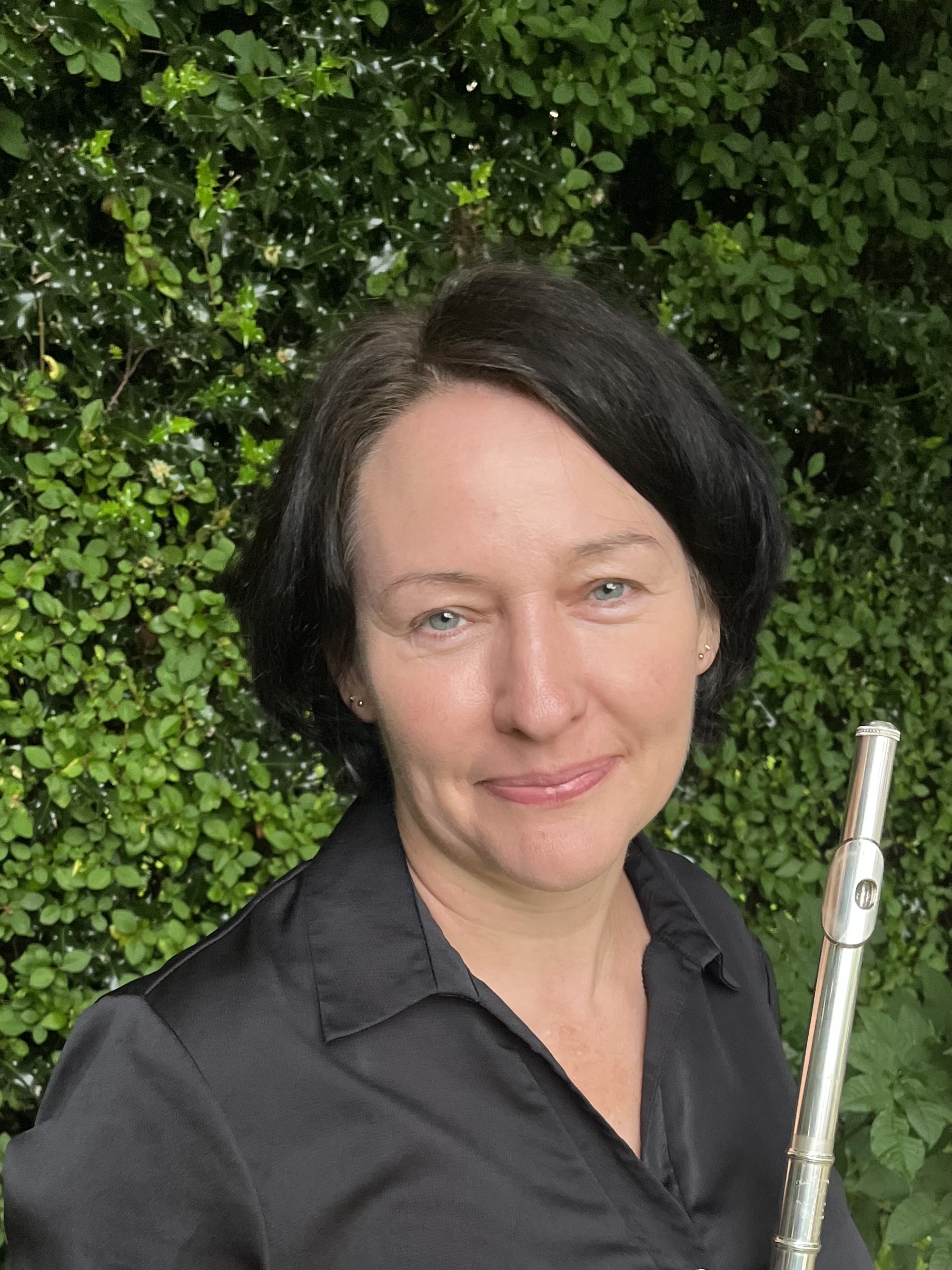 Louise Townsend (principal flute) has played with the Alderley Edge Symphony Orchestra since 2008, previously on flute and piccolo and as principal since 2023. She also regularly plays with other orchestras in the region and enjoys flute trios. She took up the flute aged 10 and played in the Lancashire Schools Symphonic Wind Band and then her college and university orchestras at Durham. Keen to continue playing when she started work, she joined the Altrincham Concert Orchestra where she played for many years.
Outside of music, Louise is a financial services lawyer and enjoys park run, the Lake District and walking with her West Highland Terrier.
Although the flute has been around for many centuries, it did not come into general orchestral use until the early 18th century. The mechanics of the instrument are relatively straightforward: a silver or wooden tube is closed off at one end and an aperture is cut into the side, across which the players blows to produce the required note. The modern design of flute owes much to the German maker Theobald Boehm who, in the 1830s, worked out the correct position for the holes along the length of the instrument which determine the pitch of each note and developed the system of keys that enable the player to finger the notes with ease.
The range of the standard orchestral flute extends some three octaves above middle C; it is not a transposing instrument and music is therefore notated at concert pitch. Higher passages require the tiny piccolo which has a similar compass above top D (although the upper notes can be difficult to control), whilst at the other end of the scale the alto flute makes an occasional appearance to provide notes down to a low G.
An outstanding characteristic of the flute family is its tremendous agility and the repertoire is full of dazzling sequences that enable the player to demonstrate his or her skills. The great solo in Ravel's Daphnis and Chloé culminates in a tremendous exhibition of flute virtuosity, and amongst other well-known orchestral works for the flute are Mozart's flute concertos, the Serenade for flute, violin and viola by Beethoven and Bach's Suite in B minor.
Yvonne Paul (principal oboe)
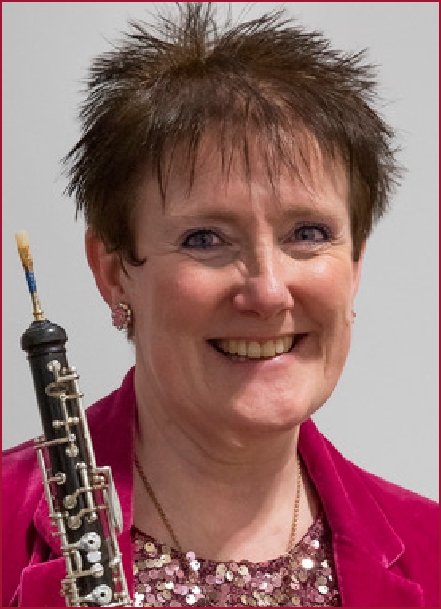 Yvonne Paul ) joined the Alderley Edge Symphony Orchestra in 2023.
Yvonne is a very experienced oboist who also plays with Oldham Symphony Orchestra, Gorton Philharmonic Orchestra and Blue Light Symphony Orchestra in London. Music has taken her abroad to perform in Germany, Bratislava and Czeckoslovakia.
Her love of the oboe dates back to her schooldays when her music teacher handed her a dusty Boosey & Hawkes plastic oboe from the top shelf of the music cupboard. Enjoying the instrument greatly, she received lessons from a peripatetic teacher and in due course joined the school orchestra. Graduating to a better instrument, she also became a member of the Sefton Youth Orchestra and Merseyside Youth Orchestra.
In addition to her orchestral playing, Yvonne also plays in various musical shows in the theatre pit, in various quintets and decets, and for weddings. She has also performed for the late Queen on two occasions.
In her spare time she loves dog-walking with her precious pekingese 'Fergus' who shares her love of music and often travels with her to rehearsals as a 'Musical Mascot'!
The Principal Oboe is the only member of the orchestra who plays a solo at every concert in which he or she appears, for it is this player - who in terms of tuning is in charge of the orchestra's quality control department - who is required to deliver the piercing 'A' at the beginning of each concert against which players carefully tune their instruments in order to achieve good intonation. The only exception is a occasional concert for which the services of the oboes are not required, in which case the responsibility is borne by the first clarinet or, in string music, by the leader or principal.he Principal Oboe is the only member of the orchestra who plays a solo at every concert in which he or she
It may be worth recording that the 'A' to which the Principal Oboe tunes his or her own instrument (using either a tuning fork or, more often nowadays, an electronic tuning device) represents a sound vibrating at a frequency of 440 cycles per second. This standardisation has not been achieved without a struggle. In Handel's day, an 'A' was 422.5, and this pitch (plus or minus the odd cycle) remained the standard throughout the period of Haydn, Mozart and Beethoven. However, the development of brass instruments for military bands (which were found to sound more brilliant at a higher pitch) led to the orchestral 'A' rising to 448 (for example, at the Paris Opera in 1858) and as high as 456.1 around the same time in Vienna.
In 1859, a commission was solemnly appointed in France to restore order from chaos, and its worthy members (who included Berlioz, Meyerbeer and Rossini) settled for a pitch of 435. Meanwhile, across the Channel, the London Philharmonic Society preferred 433, although it would fortunately have needed a very discerning pair of ears to detect the difference. But still the pitch would not stabilise: the growth of international radio in the 1920s and 1930s revealed embarrassing variations ranging from a dour 439.5 in Denmark to a shrill 443.5 in the UK. To the relief of all concerned, an International Conference in London in 1939 unanimously agreed to adopt '440 cycles per second for the note A in the treble clef,' to which the British Standards Institution thoughtfully added the qualification 'at 20 degrees Centrigrade'.
The oboe itself has its origins in the ancient folk instrument generally known as the shawm, being developed into the instrument we recognise today by the Hoteterre family who were very active in Paris during the seventeenth century as makers of woodwind instruments including the oboe (or 'hautboy'), flute, bassoon and bagpipes.
The two distinguishing characteristics of the oboe family are its conical bore with a slightly flared bell and the use of a double reed; both these differentiate it from the clarinets with their cylindrical body and single reed. If oboe players themselves have a single unique characteristic, it is their constant preoccupation with the correct functioning of their reeds; and, because of this, they are for ever scraping and testing them in the hope of producing one to take them safely through the next concert. The manufacture and titivation of reeds is indeed almost as much a part of mastering the oboe as a good technique with the keys.
The oboe has a range of just over two octaves, extending from B flat below middle C to a high G. Its music is generally notated at concert pitch, the only exception being the alto oboe (usually known as the cor anglais) which is pitched in F and is played as a transposing instrument.
In terms of repertoire, the oboe's penetrating tone makes it a prominent participant in any composition in which it appears. There are a number of well-loved concertos by such composers as Handel, Haydn, Mozart and Richard Strauss. The instrument also has many exposed solo passages in works such as Ravel's Tombeau de Couperin and Kodály's Dances of Galanta, and the cor anglais's famous solo in the second movement of Dvorak's New World Symphony must surely be amongst the most famous in the entire musical repertory.
Louise Townsend (principal flute) has played with the Alderley Edge Symphony Orchestra since 2008, previously on flute and piccolo and as principal since 2023. She also regularly plays with other orchestras in the region and enjoys flute trios. She took up the flute aged 10 and played in the Lancashire Schools Symphonic Wind Band and then her college and university orchestras at Durham. Keen to continue playing when she started work, she joined the Altrincham Concert Orchestra where she played for many years.Outside of music, Louise is a financial services lawyer and enjoys park run, the Lake District and walking with her West Highland Terrier.
Although the flute has been around for many centuries, it did not come into general orchestral use until the early 18th century. The mechanics of the instrument are relatively straightforward: a silver or wooden tube is closed off at one end and an aperture is cut into the side, across which the players blows to produce the required note. The modern design of flute owes much to the German maker Theobald Boehm who, in the 1830s, worked out the correct position for the holes along the length of the instrument which determine the pitch of each note and developed the system of keys that enable the player to finger the notes with ease.
The range of the standard orchestral flute extends some three octaves above middle C; it is not a transposing instrument and music is therefore notated at concert pitch. Higher passages require the tiny piccolo which has a similar compass above top D (although the upper notes can be difficult to control), whilst at the other end of the scale the alto flute makes an occasional appearance to provide notes down to a low G.
An outstanding characteristic of the flute family is its tremendous agility and the repertoire is full of dazzling sequences that enable the player to demonstrate his or her skills. The great solo in Ravel's Daphnis and Chloé culminates in a tremendous exhibition of flute virtuosity, and amongst other well-known orchestral works for the flute are Mozart's flute concertos, the Serenade for flute, violin and viola by Beethoven and Bach's Suite in B minor.
Yvonne Paul (principal oboe)
Yvonne Paul ) joined the Alderley Edge Symphony Orchestra in 2023.Yvonne is a very experienced oboist who also plays with Oldham Symphony Orchestra, Gorton Philharmonic Orchestra and Blue Light Symphony Orchestra in London. Music has taken her abroad to perform in Germany, Bratislava and Czeckoslovakia.
Her love of the oboe dates back to her schooldays when her music teacher handed her a dusty Boosey & Hawkes plastic oboe from the top shelf of the music cupboard. Enjoying the instrument greatly, she received lessons from a peripatetic teacher and in due course joined the school orchestra. Graduating to a better instrument, she also became a member of the Sefton Youth Orchestra and Merseyside Youth Orchestra.
In addition to her orchestral playing, Yvonne also plays in various musical shows in the theatre pit, in various quintets and decets, and for weddings. She has also performed for the late Queen on two occasions.
In her spare time she loves dog-walking with her precious pekingese 'Fergus' who shares her love of music and often travels with her to rehearsals as a 'Musical Mascot'!
The Principal Oboe is the only member of the orchestra who plays a solo at every concert in which he or she appears, for it is this player - who in terms of tuning is in charge of the orchestra's quality control department - who is required to deliver the piercing 'A' at the beginning of each concert against which players carefully tune their instruments in order to achieve good intonation. The only exception is a occasional concert for which the services of the oboes are not required, in which case the responsibility is borne by the first clarinet or, in string music, by the leader or principal.he Principal Oboe is the only member of the orchestra who plays a solo at every concert in which he or she
It may be worth recording that the 'A' to which the Principal Oboe tunes his or her own instrument (using either a tuning fork or, more often nowadays, an electronic tuning device) represents a sound vibrating at a frequency of 440 cycles per second. This standardisation has not been achieved without a struggle. In Handel's day, an 'A' was 422.5, and this pitch (plus or minus the odd cycle) remained the standard throughout the period of Haydn, Mozart and Beethoven. However, the development of brass instruments for military bands (which were found to sound more brilliant at a higher pitch) led to the orchestral 'A' rising to 448 (for example, at the Paris Opera in 1858) and as high as 456.1 around the same time in Vienna.
In 1859, a commission was solemnly appointed in France to restore order from chaos, and its worthy members (who included Berlioz, Meyerbeer and Rossini) settled for a pitch of 435. Meanwhile, across the Channel, the London Philharmonic Society preferred 433, although it would fortunately have needed a very discerning pair of ears to detect the difference. But still the pitch would not stabilise: the growth of international radio in the 1920s and 1930s revealed embarrassing variations ranging from a dour 439.5 in Denmark to a shrill 443.5 in the UK. To the relief of all concerned, an International Conference in London in 1939 unanimously agreed to adopt '440 cycles per second for the note A in the treble clef,' to which the British Standards Institution thoughtfully added the qualification 'at 20 degrees Centrigrade'.
The oboe itself has its origins in the ancient folk instrument generally known as the shawm, being developed into the instrument we recognise today by the Hoteterre family who were very active in Paris during the seventeenth century as makers of woodwind instruments including the oboe (or 'hautboy'), flute, bassoon and bagpipes.
The two distinguishing characteristics of the oboe family are its conical bore with a slightly flared bell and the use of a double reed; both these differentiate it from the clarinets with their cylindrical body and single reed. If oboe players themselves have a single unique characteristic, it is their constant preoccupation with the correct functioning of their reeds; and, because of this, they are for ever scraping and testing them in the hope of producing one to take them safely through the next concert. The manufacture and titivation of reeds is indeed almost as much a part of mastering the oboe as a good technique with the keys.
The oboe has a range of just over two octaves, extending from B flat below middle C to a high G. Its music is generally notated at concert pitch, the only exception being the alto oboe (usually known as the cor anglais) which is pitched in F and is played as a transposing instrument.
In terms of repertoire, the oboe's penetrating tone makes it a prominent participant in any composition in which it appears. There are a number of well-loved concertos by such composers as Handel, Haydn, Mozart and Richard Strauss. The instrument also has many exposed solo passages in works such as Ravel's Tombeau de Couperin and Kodály's Dances of Galanta, and the cor anglais's famous solo in the second movement of Dvorak's New World Symphony must surely be amongst the most famous in the entire musical repertory.