VIOLINS
Shahla Armitage (leader)
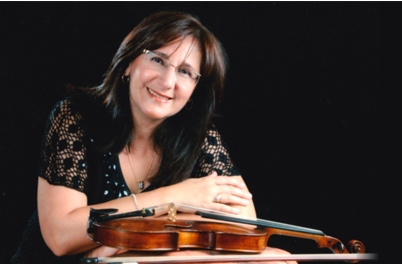 Shahla Armitage (leader) was born in Baghdad and started playing the violin at an early age. She studied violin and piano under Russian tutors at the Music and Ballet School and later through a scholarship at the Mendelssohn Hochschule in Leipzig (now The University of Music and Theatre ‘Felix Mendelssohn Bartholdy’ Leipzig). After graduation she joined the Iraqi National Symphony Orchestra and had many appearances with the Orchestra. Shahla has performed in many countries in the Middle East, Russia and Eastern Europe. Moving to Jordan she joined the Orchestra of the National Music Conservatoire (now Amman Symphony Orchestra) and at the same time established herself as a respected and sought after Violin and Piano tutor.
Since settling in the UK in 1997 she has played with a number of local orchestras including Wilmslow and Stockport Symphony Orchestras, the Vale Royal String Orchestra, Lancashire Chamber Orchestra and Sale Chamber Orchestra, performing many concerts and giving a number of recitals. She has established a school of private Violin and Piano students and teaches Violin and Piano at local schools. In 2007 Shahla established an annual tutored music event which has proved very popular and has grown year by year. She leads the Chordiale String Quartet which has given a number of charitable performances and other events. Since 2022 Shalha has been leader of the Manchester Opera Orchestra.
Shahla has a teaching Diploma from the Music and Ballet School and is a Licentiate of Trinity College London.
The strings form the core of the symphony orchestra. Between them, the violins, violas, cellos and double basses have a total compass of some six octaves and have a range of expression unmatched by any other orchestral instrument.
There are many ways in which a string can be bowed in order to achieve a particular musical effect. These include playing close to the bridge ('sul ponticello') which produces a harsh, wiry sound; and playing over the fingerboard ('sul tasto') which produces a more ethereal tone. Bowings can be long or short, and both on the string and off, the latter ('spiccato') producing extremely short notes in detached style. Occasionally, as in the Witches' Sabbath in Berlioz's Symphonie Fantastique, a composer will require players to use the wooden part of their bows rather than the hair ('col legno'); and Rossini goes one step further in his Il Signor Bruschino by requiring players to use their bows as percussion instruments by tapping their music stands.
The use of up-bows or down-bows is another matter of vital concern to the string player, and is often the subject of considerable debate at rehearsal. Whilst many passages can be bowed 'as they come', there are inevitable musical phrases for which the bowing is a question of interpretation and therefore a source of potential dispute. In hired sets of parts, these passages are reliably identified by heavily pencilled (and often contradictory) bowing marks leading, in extreme cases, to holes in the paper where an eraser has been used once too often. A good conductor and leader always ensure that such contentious bowings are sorted out at an early stage rather than running the risk of wasting valuable rehearsal time.
Bowings are not always left to the discretion of players and conductors: composers and publishers' editors often have their own ideas (sometimes erroneous) on the bowings they believe to be necessary to achieve the desired musical effect. A notable example is the Finale of Tchaikovsky's Symphony No. 2 ('Little Russian') in which the composer calls for no fewer than 52 successive high-speed quaver down-bows - a searching test of string ensemble.
The ways in which the strings are fingered also have a profound bearing on the nature and quality of the note produced. The shaking of the left hand which produces the distinctive 'vibrato' effect is an important part of a string player's technique; but on occasion, players are required to produce a remote glassy sound by touching the string with extreme lightness to produce harmonics.
Another way in which a distinctive effect can be produced is by the use of mutes. At one time, these were small stand-alone devices made of wood or metal which could be lightly clamped to the bridge as required, thereby producing a much quieter, softer sound. They also had an alarming inclination to go missing when required, or fall embarrassingly to the floor with a resounding tinkle during pianissimo passages; as a result, most players today prefer to use contrivances which locate permanently on the strings near the tailpiece and which can be quickly and safely brought into play at the appropriate moment.
A characteristic of the strings shared only with the harp, piano and organ is the ability to play more than one note at a time, achieved by stopping and bowing a number of strings simultaneously. Double or triple stopping of chords is a common requirement, but the concave shape of the modern bow (developed by the great Parisian maker Fran çois Tourte (1747-1835) makes it possible to achieve quadruple stopping only by spreading the chord to some degree. In an orchestral context, multiple stopping is normally only required over individual chords where a composer is seeking a particularly rich harmony; for extended passages, players are more than happy to share the notes between themselves on an agreed basis (playing 'divisi').
Amy Cusick (principal Second Violin )
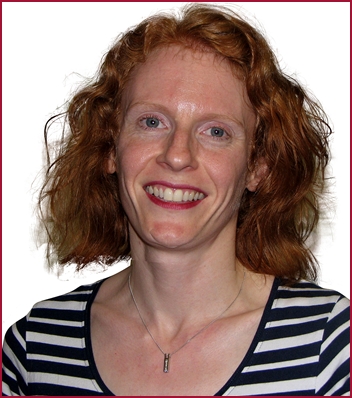 Amy Cusick has been playing the violin and piano for over 30 years, having achieved grade 8 ABRSM on both instruments. Music has always been an important part of her life: at one time she was in six orchestras and has performed in such venues as the Royal Albert Hall and the Festival Hall. However, she now has a young daughter so her hobby time is limited and she currently plays in only two orchestras.
She has been a member of the Alderley Edge Orchestra since 2011, originally in the first violins and now leading the seconds. She enjoys playing and listening to baroque and classical musical, especially Beethoven and Dvorak - in fact, anything with a good melody!
Amy is a primary school and music teacher, and has been teaching for 14 years. She thoroughly enjoys working with young children and, as a new mum herself, watching them progress and develop.
There are no words more likely to bring colour to the cheeks of the Second Violins than the phrase 'playing second fiddle', with its implication that their role is somehow inferior or subordinate to that of the Firsts. But there is no doubting that their parts are often (though not always) less demanding than those of the First Violins and certainly involve fewer excursions to the higher reaches of the fingerboard.
The pleasure for most Second Violins comes not from 'playing the tune' - a privilege which undeniably usually falls to the Firsts - but from supplying, in the company of the violas, cellos and basses, those vital harmonies which can transform even the most banal of musical themes into pieces of music with real light and shade. There is also the fascination of observing the different ways in which composers approach this task: the delicate counterpoint of Bach, the embroidery of Mendelssohn, the even-handedness of Dvorak (who, as an orchestral player himself, always went to great pains to share out the tunes), the hammered-out semi-quavers of Beethoven; and so on.
On the concert platform, the Second Violins are usually located alongside the Firsts, and this is the arrangement favoured by The Alderley Edge Orchestra in the interests of achieving a good ensemble. An alternative layout, whereby the Seconds are located to the right of the conductor as a mirror image of the Firsts, has its adherents although it is less common today than it used to be. In fact, such an arrangement can occasionally make better musical sense, especially in passages (for example, the famous opening bars of the finale of Tchaikovsky's Symphonie Pathétique) where a composer has clearly written antiphonal parts with such physical separation in mind and which lose much of their impact in the more conventional string layout.
VIOLAS
To be appointed (principal Viola)
In constructional terms, the viola is very much like a violin - it's just a larger version. But how much larger?
Oddly enough, the dimensions of the viola have never been standardised to the same degree as the violin, largely because the true 'optimum' size would be inconveniently heavy and awkward to play. Its strings are tuned a fifth lower than those of a violin: C, G, D and A. If we take the body length of the average violin as 14 inches, this would indicate an ideal viola body of around 21 inches - not the handiest of instruments to play under the chin.
So, inevitably, the design of violas tends to be a compromise between the requirements of acoustics and practicability. A typical body length is about 16 inches, although the well-known 'Tertis' model (pioneered by the outstanding English viola virtuoso Lionel Tertis (1876-1975) is nearer 17 inches in length. 'Full-length' violas have also been constructed, to be played like cellos using an endpin.
The repertoire for the viola as a solo instrument used to be somewhat limited: until recent times, the only significant composition was Berlioz's Harold in Italy, commissioned by Paganini so that he could try out his new Stradivari viola. The first performance of the work was something of a disaster. Paganini had to send a deputy as he was ill and, as Berlioz wryly observed, halfway through the performance the harpist lost her place and the conductor lost his head.
Today, however, the repertoire has been extended through the efforts of a number of contemporary composers. In Germany, Hindemith - himself a viola player - composed many works for the instrument, and it was perhaps appropriate that he should himself be the soloist in the first performance of another great viola work, William Walton's Viola Concerto. Rubbra and Fricker also wrote concertos and Brahms composed some viola sonatas.
For reasons lost in the history of music, viola players have been the butt of the so-called 'viola joke' of which many thousands must now be in circulation. The abysmal quality of most of these jokes may be judged by the following three examples taken from the 'quality' end of the genre:
Q. What is the difference between a front-desk viola player and a back-desk viola player?
A. About a semitone.
Q. Please, would you like to contribute £10 to bury a poor viola player?
A. Here's £100, Bury ten of 'em!
Q. How did the viola audition go?
A. Terrible! I had to enter the room and find the music from memory!
It says a lot for the stoicism of the viola player that jokes like these have been borne with such dignity for so many years. But there are signs that violists are starting to fight back:
Q. Why are viola jokes always so short?
A. So that the rest of the orchestra can understand them . . .
It will come as no surprise that there is a website devoted to The Viola Joke.
CELLOS
Heather Broadbent (principal Cello)
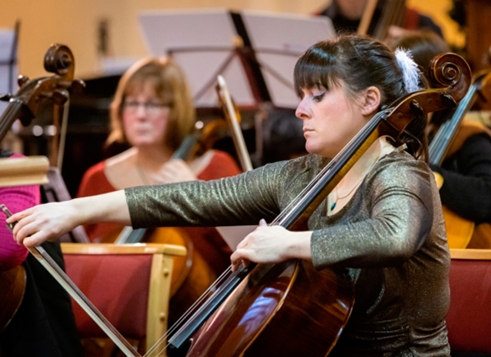 Heather Broadbent was born in Huddersfield and began learning the cello at the age of five. She emigrated to New Zealand at the age of 12 where she gained a distinction in her grade 8 and won a single study scholarship to study the cello at Auckland University. During this time Heather was recognised as a ‘high scorer’ and won the prestigious ‘Westpac’ Chamber music competition. She also appeared on TV in a progamme about New Zealand’s Young Performers.
Heather returned to the UK and continued her studies at the Royal Scottish Academy of Music and Drama. She was given a beautiful ‘Vuillaume’ cello and studied with Mark Bailey and Rudi De Groote. She participated in masterclasses with Robert Cohen, Raphael Wallfisch and Tsyoshi Tsutsumi and was nominated to participate in the Manchester Cello Festival held at the RNCM. During this visit, Heather met Rostropovich, Janos Starker, Mischa Maisky and many more inspirational figures in the cello world. Heather performed Bloch’s Schelomo with the BBC Scottish Symphony Orchestra and Saint-Saëns’ Cello Concerto with the Yorkshire Youth Orchestra during a tour of Italy.
In 2005 Heather continued her studies at the Royal Northern College of Music under Bernard Gregor Smith. She was given an English Cello by the renowned luthier Simon Forster. She continued to play chamber music and wrote a thesis on Student’s views of having multiple teachers at Music College. She became interested in Alexander Technique and attended a course in Andalusia in Spain where she performed as soloist and chamber musician alongside her teacher. The years that followed combined a teaching career and Orchestral playing. Heather was a regular player with the Orchestra of Opera North and she continued her solo playing at a variety of music festivals and societies across the North West.
After completing a PGCE in 2011, Heather embarked on a teaching career and worked as a music teacher in both primary and secondary education. She built up an ensemble of young female cellists The Cellisters at one of her schools and has always been an advocate for the subject of Music, its importance within the curriculum and its range of developmental benefits. Despite a change of career focus, Heather has always remained a keen performer and enjoys nothing more than experiencing the magic that happens when live music is experienced. As a musician, Heather enjoys sharing this experience with others and providing opportunities that go beyond the scope of the concert hall and offering it to as many diverse groups as possible.
The cello first appeared in the sixteenth century but its importance dates from the seventeenth century when composers started to use it in a continuo role to support the bass line. As its importance grew, composers from the eighteenth century onwards have contributed to the instrument's repertoire, and the concertos by Haydn, Dvorak and Elgar have achieved enormous popularity. Outstanding soloists in recent years have included Jacqueline du Pre, Pablo Casals, Paul Tortlelier and Mstislav Rostropovitch.
Cellos are roughly twice the size of violins, so to play a cello under the chin in the style of a violinist requires a player at least 11ft (3.5m) in height. As such players are very rare in Cheshire, England (though the problem may be less acute in America, where most things seem to be on a larger scale), the Alderley Edge cellists invariably adopt the more familiar posture whereby the cello is played the other way up, supported by a short adjustable spike at the tailpiece end of the instrument.
These spikes are viewed with some alarm by those who rent out concert halls; and with good reason, as they can all too readily leave behind evidence of 'a good hard play' in the form of a neatly bored hole in the hitherto immaculate concert platform. The thoughtful cellist will therefore bring along his or her tiny piece of portable floor, which can be anchored to the chair for the duration of the concert.
BASSES
Martin Stuart (principal Bass)
The double bass differs from the other members of the string family - the violin, the viola and the cello - in a number of important ways.
Firstly, it is physically different from the other strings rather than just being a scaled up version. The design of the double bass dates back to the days of the viol, an early design of string instrument in use from the 15th to 18th century, and to this day the bass has retained the viol's distinctive sloping shoulders. The so-called Dragonetti bow, held from below rather than above, is another feature more characteristic of the viol rather than the violin family.
Another unusual characteristic of the bass is that it is the only member of the string family that is a transposing instrument; in other words, the sound it makes is not the sound written in the part. The explanation is again largely historical. The traditional role of the double bass in the early classical orchestra was to echo or 'double' the part of the cellos, but playing it an octave lower in pitch to add greater sonority. As a result, the bass player was simply required to follow the music of the cellos and rely on his instrument to transpose it automatically into the correct pitch one octave lower. Although later composers started to write separate, unique parts for the bass, the practice of writing in the bass clef of the cellos has been retained to this day.
Yet another oddity of the double bass is that it is the only member of the string family to be tuned in fourths rather than fifths. The explanation here is physical: the much greater distance between the notes on the keyboard of a bass makes it impossible for a player to stretch further than an interval of a fourth, and the instrument is therefore tuned to the notes of low E, A, D and G. But unfortunately the matter does not end here. A lack of standardisation in the tuning of early basses has resulted in an occasional requirement (even in music as 'late' as that of Bach and Mozart) for lower notes down as far as C. This has resulted in a further curiosity of the double bass family: the five-stringed instrument, the fifth string being tuned specially to B or C to meet this awkward requirement.
In fairness, it should be said that the five-string bass is by no means a fully accepted concept, as many players insist that a five-stringer is acoustically inferior to the normal four-string instrument. Indeed, some players prefer a four-string instrument with a so-called 'piccolo extension', a rather ugly extension to the fingerboard which can be brought into play as required to extend the E down to B or C. Others players will turn a blind eye to the problem and discreetly play the offending notes an octave higher, or not play them at all depending on the whims of the conductor or composer.
The double bass is undoubtedly a member of the orchestra's supporting cast rather than an instrument with soloistic ambitions. However, Stravinsky composed a challenging duet for double bass and trombone in Pulcinella, and Mahler's famous Frère Jacques parody in his First Symphony gives the double bass a moment of real glory. In recent times, the instrument has received greater prominence thanks to the efforts of the Russian-born American composer and double bass virtuoso Serge Alexandrovitch Koussevitzky (1874-1951). Diana Wanklyn, principal double bass of the Hallé Orchestra, joined The Alderley Edge Orchestra for a performance of Koussevitsky's Double Bass Concerto in October 1997.
Shahla Armitage (leader)
Shahla Armitage (leader) was born in Baghdad and started playing the violin at an early age. She studied violin and piano under Russian tutors at the Music and Ballet School and later through a scholarship at the Mendelssohn Hochschule in Leipzig (now The University of Music and Theatre ‘Felix Mendelssohn Bartholdy’ Leipzig). After graduation she joined the Iraqi National Symphony Orchestra and had many appearances with the Orchestra. Shahla has performed in many countries in the Middle East, Russia and Eastern Europe. Moving to Jordan she joined the Orchestra of the National Music Conservatoire (now Amman Symphony Orchestra) and at the same time established herself as a respected and sought after Violin and Piano tutor.Since settling in the UK in 1997 she has played with a number of local orchestras including Wilmslow and Stockport Symphony Orchestras, the Vale Royal String Orchestra, Lancashire Chamber Orchestra and Sale Chamber Orchestra, performing many concerts and giving a number of recitals. She has established a school of private Violin and Piano students and teaches Violin and Piano at local schools. In 2007 Shahla established an annual tutored music event which has proved very popular and has grown year by year. She leads the Chordiale String Quartet which has given a number of charitable performances and other events. Since 2022 Shalha has been leader of the Manchester Opera Orchestra.
Shahla has a teaching Diploma from the Music and Ballet School and is a Licentiate of Trinity College London.
The strings form the core of the symphony orchestra. Between them, the violins, violas, cellos and double basses have a total compass of some six octaves and have a range of expression unmatched by any other orchestral instrument.
There are many ways in which a string can be bowed in order to achieve a particular musical effect. These include playing close to the bridge ('sul ponticello') which produces a harsh, wiry sound; and playing over the fingerboard ('sul tasto') which produces a more ethereal tone. Bowings can be long or short, and both on the string and off, the latter ('spiccato') producing extremely short notes in detached style. Occasionally, as in the Witches' Sabbath in Berlioz's Symphonie Fantastique, a composer will require players to use the wooden part of their bows rather than the hair ('col legno'); and Rossini goes one step further in his Il Signor Bruschino by requiring players to use their bows as percussion instruments by tapping their music stands.
The use of up-bows or down-bows is another matter of vital concern to the string player, and is often the subject of considerable debate at rehearsal. Whilst many passages can be bowed 'as they come', there are inevitable musical phrases for which the bowing is a question of interpretation and therefore a source of potential dispute. In hired sets of parts, these passages are reliably identified by heavily pencilled (and often contradictory) bowing marks leading, in extreme cases, to holes in the paper where an eraser has been used once too often. A good conductor and leader always ensure that such contentious bowings are sorted out at an early stage rather than running the risk of wasting valuable rehearsal time.
Bowings are not always left to the discretion of players and conductors: composers and publishers' editors often have their own ideas (sometimes erroneous) on the bowings they believe to be necessary to achieve the desired musical effect. A notable example is the Finale of Tchaikovsky's Symphony No. 2 ('Little Russian') in which the composer calls for no fewer than 52 successive high-speed quaver down-bows - a searching test of string ensemble.
The ways in which the strings are fingered also have a profound bearing on the nature and quality of the note produced. The shaking of the left hand which produces the distinctive 'vibrato' effect is an important part of a string player's technique; but on occasion, players are required to produce a remote glassy sound by touching the string with extreme lightness to produce harmonics.
Another way in which a distinctive effect can be produced is by the use of mutes. At one time, these were small stand-alone devices made of wood or metal which could be lightly clamped to the bridge as required, thereby producing a much quieter, softer sound. They also had an alarming inclination to go missing when required, or fall embarrassingly to the floor with a resounding tinkle during pianissimo passages; as a result, most players today prefer to use contrivances which locate permanently on the strings near the tailpiece and which can be quickly and safely brought into play at the appropriate moment.
A characteristic of the strings shared only with the harp, piano and organ is the ability to play more than one note at a time, achieved by stopping and bowing a number of strings simultaneously. Double or triple stopping of chords is a common requirement, but the concave shape of the modern bow (developed by the great Parisian maker Fran çois Tourte (1747-1835) makes it possible to achieve quadruple stopping only by spreading the chord to some degree. In an orchestral context, multiple stopping is normally only required over individual chords where a composer is seeking a particularly rich harmony; for extended passages, players are more than happy to share the notes between themselves on an agreed basis (playing 'divisi').
Amy Cusick (principal Second Violin )
Amy Cusick has been playing the violin and piano for over 30 years, having achieved grade 8 ABRSM on both instruments. Music has always been an important part of her life: at one time she was in six orchestras and has performed in such venues as the Royal Albert Hall and the Festival Hall. However, she now has a young daughter so her hobby time is limited and she currently plays in only two orchestras.She has been a member of the Alderley Edge Orchestra since 2011, originally in the first violins and now leading the seconds. She enjoys playing and listening to baroque and classical musical, especially Beethoven and Dvorak - in fact, anything with a good melody!
Amy is a primary school and music teacher, and has been teaching for 14 years. She thoroughly enjoys working with young children and, as a new mum herself, watching them progress and develop.
There are no words more likely to bring colour to the cheeks of the Second Violins than the phrase 'playing second fiddle', with its implication that their role is somehow inferior or subordinate to that of the Firsts. But there is no doubting that their parts are often (though not always) less demanding than those of the First Violins and certainly involve fewer excursions to the higher reaches of the fingerboard.
The pleasure for most Second Violins comes not from 'playing the tune' - a privilege which undeniably usually falls to the Firsts - but from supplying, in the company of the violas, cellos and basses, those vital harmonies which can transform even the most banal of musical themes into pieces of music with real light and shade. There is also the fascination of observing the different ways in which composers approach this task: the delicate counterpoint of Bach, the embroidery of Mendelssohn, the even-handedness of Dvorak (who, as an orchestral player himself, always went to great pains to share out the tunes), the hammered-out semi-quavers of Beethoven; and so on.
On the concert platform, the Second Violins are usually located alongside the Firsts, and this is the arrangement favoured by The Alderley Edge Orchestra in the interests of achieving a good ensemble. An alternative layout, whereby the Seconds are located to the right of the conductor as a mirror image of the Firsts, has its adherents although it is less common today than it used to be. In fact, such an arrangement can occasionally make better musical sense, especially in passages (for example, the famous opening bars of the finale of Tchaikovsky's Symphonie Pathétique) where a composer has clearly written antiphonal parts with such physical separation in mind and which lose much of their impact in the more conventional string layout.
VIOLAS
To be appointed (principal Viola)
In constructional terms, the viola is very much like a violin - it's just a larger version. But how much larger?
Oddly enough, the dimensions of the viola have never been standardised to the same degree as the violin, largely because the true 'optimum' size would be inconveniently heavy and awkward to play. Its strings are tuned a fifth lower than those of a violin: C, G, D and A. If we take the body length of the average violin as 14 inches, this would indicate an ideal viola body of around 21 inches - not the handiest of instruments to play under the chin.
So, inevitably, the design of violas tends to be a compromise between the requirements of acoustics and practicability. A typical body length is about 16 inches, although the well-known 'Tertis' model (pioneered by the outstanding English viola virtuoso Lionel Tertis (1876-1975) is nearer 17 inches in length. 'Full-length' violas have also been constructed, to be played like cellos using an endpin.
The repertoire for the viola as a solo instrument used to be somewhat limited: until recent times, the only significant composition was Berlioz's Harold in Italy, commissioned by Paganini so that he could try out his new Stradivari viola. The first performance of the work was something of a disaster. Paganini had to send a deputy as he was ill and, as Berlioz wryly observed, halfway through the performance the harpist lost her place and the conductor lost his head.
Today, however, the repertoire has been extended through the efforts of a number of contemporary composers. In Germany, Hindemith - himself a viola player - composed many works for the instrument, and it was perhaps appropriate that he should himself be the soloist in the first performance of another great viola work, William Walton's Viola Concerto. Rubbra and Fricker also wrote concertos and Brahms composed some viola sonatas.
For reasons lost in the history of music, viola players have been the butt of the so-called 'viola joke' of which many thousands must now be in circulation. The abysmal quality of most of these jokes may be judged by the following three examples taken from the 'quality' end of the genre:
Q. What is the difference between a front-desk viola player and a back-desk viola player?
A. About a semitone.
Q. Please, would you like to contribute £10 to bury a poor viola player?
A. Here's £100, Bury ten of 'em!
Q. How did the viola audition go?
A. Terrible! I had to enter the room and find the music from memory!
It says a lot for the stoicism of the viola player that jokes like these have been borne with such dignity for so many years. But there are signs that violists are starting to fight back:
Q. Why are viola jokes always so short?
A. So that the rest of the orchestra can understand them . . .
It will come as no surprise that there is a website devoted to The Viola Joke.
CELLOS
Heather Broadbent (principal Cello)
Heather Broadbent was born in Huddersfield and began learning the cello at the age of five. She emigrated to New Zealand at the age of 12 where she gained a distinction in her grade 8 and won a single study scholarship to study the cello at Auckland University. During this time Heather was recognised as a ‘high scorer’ and won the prestigious ‘Westpac’ Chamber music competition. She also appeared on TV in a progamme about New Zealand’s Young Performers.Heather returned to the UK and continued her studies at the Royal Scottish Academy of Music and Drama. She was given a beautiful ‘Vuillaume’ cello and studied with Mark Bailey and Rudi De Groote. She participated in masterclasses with Robert Cohen, Raphael Wallfisch and Tsyoshi Tsutsumi and was nominated to participate in the Manchester Cello Festival held at the RNCM. During this visit, Heather met Rostropovich, Janos Starker, Mischa Maisky and many more inspirational figures in the cello world. Heather performed Bloch’s Schelomo with the BBC Scottish Symphony Orchestra and Saint-Saëns’ Cello Concerto with the Yorkshire Youth Orchestra during a tour of Italy.
In 2005 Heather continued her studies at the Royal Northern College of Music under Bernard Gregor Smith. She was given an English Cello by the renowned luthier Simon Forster. She continued to play chamber music and wrote a thesis on Student’s views of having multiple teachers at Music College. She became interested in Alexander Technique and attended a course in Andalusia in Spain where she performed as soloist and chamber musician alongside her teacher. The years that followed combined a teaching career and Orchestral playing. Heather was a regular player with the Orchestra of Opera North and she continued her solo playing at a variety of music festivals and societies across the North West.
After completing a PGCE in 2011, Heather embarked on a teaching career and worked as a music teacher in both primary and secondary education. She built up an ensemble of young female cellists The Cellisters at one of her schools and has always been an advocate for the subject of Music, its importance within the curriculum and its range of developmental benefits. Despite a change of career focus, Heather has always remained a keen performer and enjoys nothing more than experiencing the magic that happens when live music is experienced. As a musician, Heather enjoys sharing this experience with others and providing opportunities that go beyond the scope of the concert hall and offering it to as many diverse groups as possible.
The cello first appeared in the sixteenth century but its importance dates from the seventeenth century when composers started to use it in a continuo role to support the bass line. As its importance grew, composers from the eighteenth century onwards have contributed to the instrument's repertoire, and the concertos by Haydn, Dvorak and Elgar have achieved enormous popularity. Outstanding soloists in recent years have included Jacqueline du Pre, Pablo Casals, Paul Tortlelier and Mstislav Rostropovitch.
Cellos are roughly twice the size of violins, so to play a cello under the chin in the style of a violinist requires a player at least 11ft (3.5m) in height. As such players are very rare in Cheshire, England (though the problem may be less acute in America, where most things seem to be on a larger scale), the Alderley Edge cellists invariably adopt the more familiar posture whereby the cello is played the other way up, supported by a short adjustable spike at the tailpiece end of the instrument.
These spikes are viewed with some alarm by those who rent out concert halls; and with good reason, as they can all too readily leave behind evidence of 'a good hard play' in the form of a neatly bored hole in the hitherto immaculate concert platform. The thoughtful cellist will therefore bring along his or her tiny piece of portable floor, which can be anchored to the chair for the duration of the concert.
BASSES
Martin Stuart (principal Bass)
The double bass differs from the other members of the string family - the violin, the viola and the cello - in a number of important ways.
Firstly, it is physically different from the other strings rather than just being a scaled up version. The design of the double bass dates back to the days of the viol, an early design of string instrument in use from the 15th to 18th century, and to this day the bass has retained the viol's distinctive sloping shoulders. The so-called Dragonetti bow, held from below rather than above, is another feature more characteristic of the viol rather than the violin family.
Another unusual characteristic of the bass is that it is the only member of the string family that is a transposing instrument; in other words, the sound it makes is not the sound written in the part. The explanation is again largely historical. The traditional role of the double bass in the early classical orchestra was to echo or 'double' the part of the cellos, but playing it an octave lower in pitch to add greater sonority. As a result, the bass player was simply required to follow the music of the cellos and rely on his instrument to transpose it automatically into the correct pitch one octave lower. Although later composers started to write separate, unique parts for the bass, the practice of writing in the bass clef of the cellos has been retained to this day.
Yet another oddity of the double bass is that it is the only member of the string family to be tuned in fourths rather than fifths. The explanation here is physical: the much greater distance between the notes on the keyboard of a bass makes it impossible for a player to stretch further than an interval of a fourth, and the instrument is therefore tuned to the notes of low E, A, D and G. But unfortunately the matter does not end here. A lack of standardisation in the tuning of early basses has resulted in an occasional requirement (even in music as 'late' as that of Bach and Mozart) for lower notes down as far as C. This has resulted in a further curiosity of the double bass family: the five-stringed instrument, the fifth string being tuned specially to B or C to meet this awkward requirement.
In fairness, it should be said that the five-string bass is by no means a fully accepted concept, as many players insist that a five-stringer is acoustically inferior to the normal four-string instrument. Indeed, some players prefer a four-string instrument with a so-called 'piccolo extension', a rather ugly extension to the fingerboard which can be brought into play as required to extend the E down to B or C. Others players will turn a blind eye to the problem and discreetly play the offending notes an octave higher, or not play them at all depending on the whims of the conductor or composer.
The double bass is undoubtedly a member of the orchestra's supporting cast rather than an instrument with soloistic ambitions. However, Stravinsky composed a challenging duet for double bass and trombone in Pulcinella, and Mahler's famous Frère Jacques parody in his First Symphony gives the double bass a moment of real glory. In recent times, the instrument has received greater prominence thanks to the efforts of the Russian-born American composer and double bass virtuoso Serge Alexandrovitch Koussevitzky (1874-1951). Diana Wanklyn, principal double bass of the Hallé Orchestra, joined The Alderley Edge Orchestra for a performance of Koussevitsky's Double Bass Concerto in October 1997.